

ABOUT IJLRES
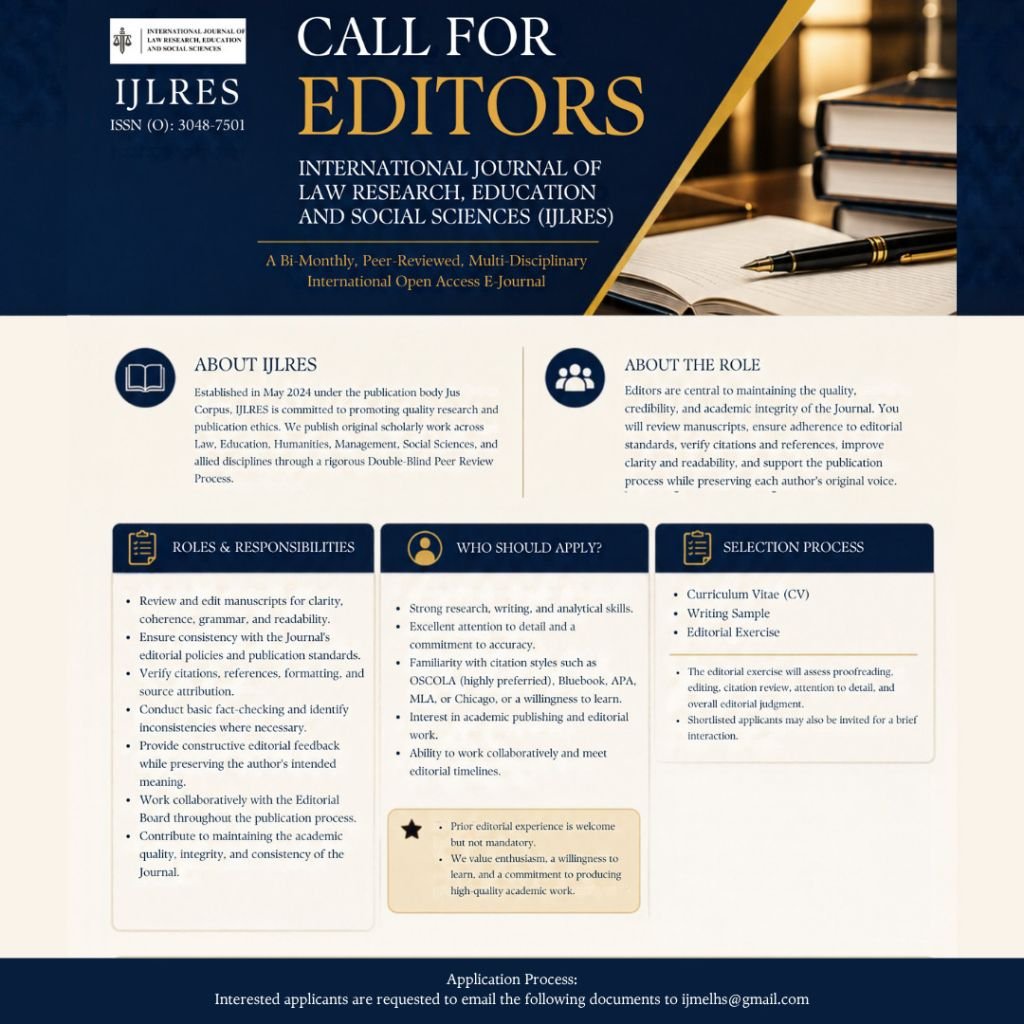
IJLRES is a Bi-Monthly, Peer-Reviewed, Multi-Disciplinary International Open Access E-Journal (ISSN (O): 3048-7501) established in May 2024 under the publication body Jus Corpus. The Journal publishes original scholarly work across Law, Education, Humanities, Management, Social Sciences, and allied disciplines through a rigorous Double-Blind Peer Review Process. Committed to promoting quality research and publication ethics, IJLRES seeks to make interdisciplinary scholarship accessible to researchers, academicians, professionals, and students worldwide.
As the Journal continues to grow, we are looking for dedicated, detail-oriented, and academically driven individuals with a passion for research, academic writing, and scholarly publishing. Joining the Editorial Board offers an opportunity to gain hands-on editorial experience while contributing to a growing international academic journal.
About the Role
Editors are central to maintaining the quality, credibility, and academic integrity of the Journal. Working closely with the Managing Editor and Editorial Board, they will review manuscripts, ensure adherence to editorial standards, verify citations and references, improve clarity and readability, and support the publication process while preserving each author’s original voice.
Roles and Responsibilities
Editors will, among other responsibilities:
- Review and edit manuscripts for clarity, coherence, grammar, and readability.
- Ensure consistency with the Journal’s editorial policies and publication standards.
- Verify citations, references, formatting, and source attribution.
- Conduct basic fact-checking and identify inconsistencies where necessary.
- Provide constructive editorial feedback while preserving the author’s intended meaning.
- Work collaboratively with the Editorial Board throughout the publication process.
- Contribute to maintaining the academic quality and integrity of the Journal.
Who Should Apply?
We encourage applications from individuals who:
- Possess strong research, writing, and analytical skills.
- Have excellent attention to detail and a commitment to accuracy.
- Are familiar with citation styles such as OSCOLA (very important), Bluebook, APA, MLA, Chicago, or are willing to learn.
- Have an interest in academic publishing and editorial work.
- Can work collaboratively while meeting editorial timelines.
Prior editorial experience is welcome but not mandatory. We value enthusiasm, a willingness to learn, and a commitment to producing high-quality academic work.
Selection Process
Applicants will be evaluated based on:
- Curriculum Vitae (CV)
- Writing Sample
- Editorial Exercise
The editorial exercise will assess proofreading, editing, citation review, and overall editorial judgment. Shortlisted applicants may also be invited for a brief interaction.
Editorial Exercise
As part of the selection process, applicants are required to complete an editorial assessment.
Topic: Social Media Regulation and Freedom of Speech in India
The rapid growth of social media has transformed the way individuals communicate, consume information and participate in public discourse. Platforms such as X (formerly Twitter), Instagram, Facebook and YouTube have become important spaces for political debate, social movements and dissemination of news. However this expansion has also resulted in growing concerns regarding misinformation, hate speech, online harassment and threats to public order. Consequently, governments around the world have attempted to regulate digital platforms, although such regulation frequently raises questions regarding freedom of speech and democratic accountability.
In India, freedom of speech and expression is guaranteed under Article 19(1)(a) of the Constitution. However this right is not absolute because Article 19(2) permits the State to impose reasonable restrictions in the interests of sovereignty and integrity of India, security of the State, public order, decency, morality, contempt of court, defamation and incitement to an offence. The Supreme Court have repeatedly observed that restrictions upon speech must satisfy constitutional standards of reasonableness and proportionality.
One of the most significant developments in this area was the enactment of the Information Technology Act, 2000. The Act provides a legal framework governing electronic communications and online intermediaries. Section 79 grants safe harbour protection to intermediaries provided they exercise due diligence and comply with statutory obligations. However, debates regarding intermediary liability continues to evolve as digital platforms exercise increasing influence over public discourse.
The controversy surrounding Section 66A of the Information Technology Act illustrates the tension between free speech and government regulation. Section 66A criminalized the sending of offensive or annoying messages through electronic communication. The provision was criticised because terms like “grossly offensive” and “annoyance” were vague and capable of arbitrary interpretation. In Shreya Singhal v Union of India the Supreme Court struck down Section 66A holding that it violated Article 19(1)(a). The judgement remains one of the landmark decisions protecting online speech in India.
Scholars have argued that effective regulation should combine legal accountability with platform transparency and digital literacy initiatives. Merely imposing stricter legal obligations upon intermediaries may not adequately address the underlying causes of misinformation or online abuse. Public education, independent fact-checking and algorithmic transparency are equally important components of a healthy digital ecosystem.
Ultimately, regulating social media requires striking a careful balance between protecting constitutional freedoms and addressing genuine harms arising from digital communication. Excessive regulation risks chilling legitimate expression, whereas insufficient regulation may permit the spread of misinformation, hate speech and coordinated manipulation of public discourse. Policymakers should therefore adopt evidence-based regulations that respects constitutional values while responding effectively to emerging technological challenges (Shreya Singhal v Union of India, (2015) 5 SCC 1).
Please complete the following exercise:
- Copy the article provided in this recruitment notice into a Microsoft Word (.doc/.docx) document.
- Turn Track Changes ON before making any edits.
- Edit the article as though it were being prepared for publication.
Your edits should include, wherever appropriate:
- Correcting grammar, spelling, punctuation, and typographical errors.
- Improving sentence structure, clarity, coherence, and readability.
- Ensuring consistency in language, formatting, and citation style.
- Identifying incorrect or incomplete citations.
- Suggesting editorial improvements while preserving the author’s intended meaning and voice.
Save the document with Track Changes visible and attach it with your application.
Appointment
A total of five (5) Editors will be selected.
Selected candidates will initially serve a two-month probationary period. Their performance, commitment, and quality of work will be evaluated by the Managing Editor and Editorial Board. Editors whose performance is found satisfactory will be retained as permanent members of the Editorial Board and will become eligible for monthly honorarium/perks in accordance with the Journal’s policies.
Application Process
Interested applicants are requested to email the following documents to ijmelhs@gmail.com:
- Curriculum Vitae (CV)
- One Writing Sample
- Completed Editorial Exercise (with Track Changes enabled)
Subject Line: Application for the Position of Editor – IJLRES
Deadline: 03 September 2026
We look forward to welcoming passionate individuals who share our commitment to academic excellence and wish to contribute to advancing high-quality interdisciplinary scholarship through the International Journal of Law Research, Education and Social Sciences.
For any queries regarding the recruitment process, please write to ijmelhs@gmail.com