

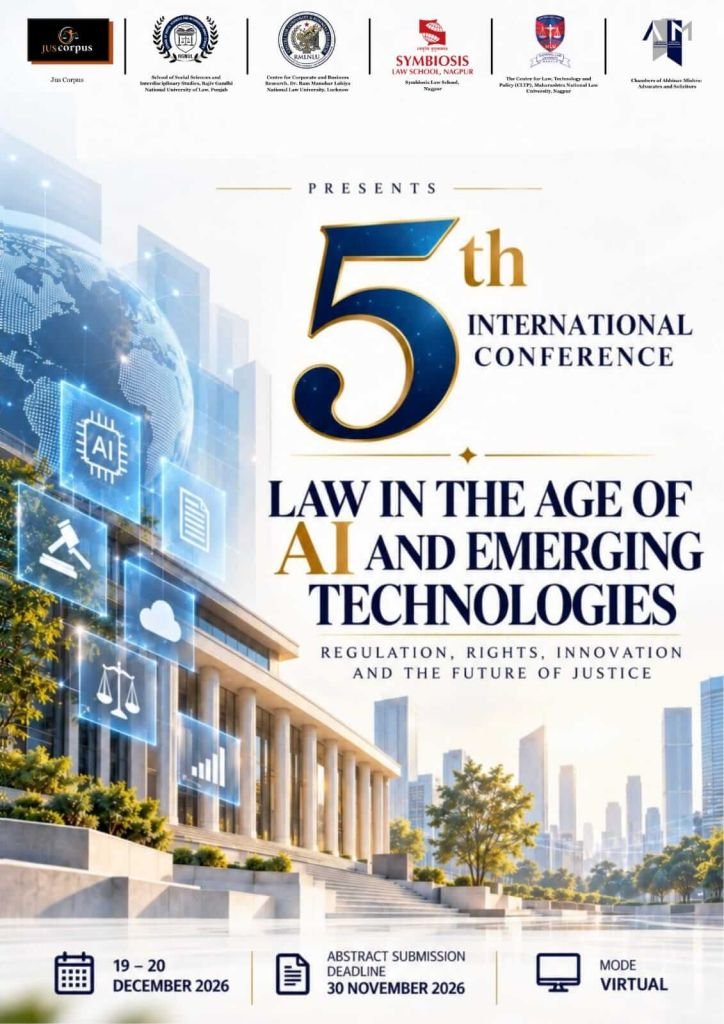
ABOUT THE CONFERENCE
Jus Corpus is pleased to present the 5th Virtual Conference on “LAW IN THE AGE OF AI AND EMERGING TECHNOLOGIES: Regulation, Rights, Innovation and the Future of Justice”, scheduled to be held on 19–20 December 2026.
Building upon its commitment to fostering meaningful academic dialogue on contemporary legal issues, this edition seeks to examine the transformative impact of Artificial Intelligence and emerging technologies on legal systems, institutions and society. As technological advancements reshape legal practice, governance, business, intellectual property and the administration of justice, they raise critical questions concerning regulation, fundamental rights, privacy, accountability, ethics and access to justice.
The conference aims to bring together academicians, legal practitioners, researchers, policymakers, technology professionals and students from India and abroad to exchange perspectives, present research and explore forward-looking approaches to the evolving relationship between law and technology.
Organised by Jus Corpus in collaboration with the School of Social Sciences and Interdisciplinary Studies, Rajiv Gandhi National University of Law, Punjab; the Centre for Corporate and Business Research, Dr. Ram Manohar Lohiya National Law University, Lucknow; and Chambers of Abhinav Mishra, Advocates and Solicitors, the conference aspires to provide an international academic platform for advancing responsible innovation, strengthening legal frameworks and shaping the future of law and justice in an increasingly technology-driven world.
OBJECTIVES OF THE CONFERENCE
Examine Emerging Legal and Regulatory Frameworks: To analyse existing and evolving legal frameworks governing artificial intelligence and emerging technologies, with particular emphasis on regulatory approaches, public policy, and comparative legal perspectives across jurisdictions.
Safeguard Fundamental Rights and Constitutional Values: To critically examine the implications of AI-driven systems for constitutional principles, human rights, privacy, equality, dignity, freedom of expression, and the protection of vulnerable groups.
Promote Responsible AI Governance: To explore principles of transparency, accountability, fairness, explainability, and ethical responsibility in the development, deployment, and regulation of AI systems.
Assess the Transformation of Legal Practice: To investigate the impact of AI on legal research, drafting, litigation, contract management, due diligence, compliance, and other professional legal services, while identifying the opportunities and challenges associated with its responsible adoption.
Explore Technology-Enabled Justice Delivery: To examine the role of AI and emerging technologies in judicial administration, legal aid, dispute resolution, arbitration, mediation, online dispute resolution, and improving access to justice.
Address Intellectual Property and Data Governance Challenges: To analyse emerging questions concerning copyright, patentability, authorship, ownership, training data, data protection, privacy, and the lawful use of information in AI development and deployment.
Investigate Cybersecurity and Digital Accountability: To evaluate the legal challenges arising from cybercrime, digital identity, algorithmic misuse, online platforms, data breaches, and the security of technology-driven systems.
Examine Sector-Specific Applications and Implications: To explore the opportunities and legal challenges associated with AI in business, corporate governance, financial services, healthcare, education, environmental protection, employment, and other emerging sectors.
Encourage Interdisciplinary and International Collaboration: To bring together academicians, legal practitioners, researchers, policymakers, technology professionals, and students to exchange knowledge, present original research, and develop comparative and interdisciplinary perspectives.
Shape the Future of Law and Justice: To identify emerging research priorities and forward-looking approaches for developing adaptable legal institutions, effective regulatory mechanisms, and inclusive justice systems in an increasingly technology-driven world.
CONFERENCE LEGACY
Jus Corpus has built a meaningful legacy through its four editions of the Virtual Conference on Women’s Rights, providing an academic platform for discussions on gender justice, social equity, legal empowerment, and the challenges faced by women across diverse societies. These editions brought together scholars, legal professionals, researchers, and students to exchange perspectives and contribute to the discourse on women’s rights and social transformation.
The 5th edition marks a significant evolution in the conference’s thematic direction. Moving beyond its earlier focus on women’s rights, this edition expands the scope of the platform to examine the broader relationship between law, artificial intelligence, and emerging technologies. Titled “Law in the Age of AI and Emerging Technologies: Regulation, Rights, Innovation and the Future of Justice,” the conference reflects the growing need to understand how technological advancements are reshaping legal frameworks, governance, fundamental rights, professional practices, and the administration of justice.
This transition represents the expansion of Jus Corpus’s academic engagement into an increasingly consequential area of legal scholarship. While the earlier editions focused on advancing gender justice and social equity, the fifth edition seeks to address the wider legal, ethical, constitutional, and regulatory questions arising from technological innovation.
Through this evolution, Jus Corpus continues its commitment to facilitating contemporary legal discourse, encouraging interdisciplinary research, and fostering collaboration among academicians, practitioners, policymakers, researchers, and students. The fifth edition seeks to establish a broader platform for examining the challenges and opportunities emerging at the intersection of law and technology, while contributing to informed debate on the future of justice in a rapidly changing world.
ORGANIsERS OF THE CONFERENCE
1. Jus Corpus
2. School of Social Sciences and Interdisciplinary Studies (SSSIS), Rajiv Gandhi National University of Law, Punjab
3. Centre for Corporate and Business Research (CCBR), Dr. Ram Manohar Lohiya National Law University, Lucknow
4. Research and Publication Cell, Symbiosis Law School, Nagpur
5. Centre for Law, Technology and Policy (CLTP), Maharashtra National Law University, Nagpur
6. Chambers of Abhinav Mishra: Advocates and Solicitors
THEME OF THE CONFERENCE
‘LAW IN THE AGE OF AI AND EMERGING TECHNOLOGIES’
Regulation, Rights, Innovation and the Future of Justice
SUB-THEMES OF THE CONFERENCE
- AI Governance, Regulation and Public Policy
- Artificial Intelligence, Constitutionalism and Fundamental Rights
- Comparative and International Approaches to AI Regulation
- Generative AI and the Transformation of Legal Practice
- Artificial Intelligence, Intellectual Property and Copyright
- Data Protection, Privacy and Digital Rights
- AI-Driven Cybercrime, Cybersecurity and Digital Evidence
- Artificial Intelligence in Judicial Administration and Access to Justice
- AI in Criminal Justice, Law Enforcement and Sentencing
- Artificial Intelligence in Corporate Governance, Financial Regulation and Compliance
- Algorithmic Bias, Transparency and Accountability
- AI Ethics, Human Dignity and Responsible Innovation
- Artificial Intelligence, Employment and the Future of Work
- Emerging Technologies, Environmental Sustainability and Legal Challenges
Research papers addressing other contemporary issues substantially connected with the central theme will also be welcomed.
ELIGIBILITY
Research papers are invited from academicians, advocates, policymakers, professors, legal practitioners, research scholars, students, technology professionals, legal-tech professionals, industry professionals and international scholars and experts.
All submissions must constitute the author(s)’ original work and must not reproduce or duplicate previously published work. Submissions shall be subject to review and approval by the Editorial Board.
Based on the quality and suitability of the submissions, selected research papers may be considered for publication in an edited book bearing an ISBN, subject to editorial approval.
Co-Authorship is permitted, with a maximum of Two Authors per research paper.
IMPORTANT DATES
A. Research Paper Presentation Category
Abstract Submission Deadline: 30 November 2026
Intimation of Abstract Acceptance: 08 November 2026
Last Date for Registration and Payment: 10 December 2026
Full Paper Submission Deadline: 14 December 2026
Inaugural Session and Panel Discussions: 19 December 2026
Technical Sessions and Research Paper Presentations: 20 December 2026
B. Participation-Only Category
Registration Opens: 08 November 2026
Last Date for Registration and Payment: 10 December 2026
Inaugural Session and Panel Discussions: 19 December 2026
IMPORTANT NOTE FOR PARTICIPANTS
The conference welcomes individuals who wish to attend the academic proceedings without presenting a research paper. Participants may register under the Participation-Only Category to attend the inaugural session and panel discussions scheduled for 19 December 2026.
Participants registered under this category are not required to submit an abstract or a full research paper and will not be required to present during the technical sessions. A Certificate of Participation will be issued to eligible attendees, subject to the conference’s attendance and certification requirements.
Those interested in presenting their research must register under the Research Paper Presentation Category and comply with the applicable submission and presentation requirements.
Please Note: Participation-only registration covers attendance at the inaugural session and panel discussions on 19 December 2026. It does not include research paper presentation or participation in the technical sessions scheduled for 20 December 2026.
SUBMISSION GUIDELINES
ABSTRACT:
- Word Limit: 150-300 (inclusive of 3-5 Keywords)
- The entire body must be in italics.
- Font: Times New Roman, Size: 12, Text Colour: Black, Alignment: Justified
- Margin: 2.54 cm (Normal), Paper: A4
- Line Spacing: 1.5, Paragraph Spacing: Add Space (Before + After) Paragraph
- The Cover page shall consist of the following details: Title of the Paper, Name of the Author(s), Official designation/institutional details, Current Residential Address, E-mail Address, and Contact details of the Author(s).
- The Subject of the E-mail for Submission of the Abstract must be “5th International Virtual Conference: Abstract Submission”.
- There must be a single file containing the Cover page and Abstract.
Submission ID: juscorpusconference@gmail.com
Note* – The Abstract and the paper must be aligned with the Theme of the Conference. The Submission must be original in nature and will be subjected to a plagiarism check.
SAMPLE COVER LETTER AND ABSTRACT – A Sample document is attached for reference to guide authors in preparing their Cover Letter and Abstract. Authors are requested to refer to the sample and follow the prescribed format while preparing their submissions for the Conference.
FINAL PAPER –
FOR MAIN BODY:
- Word Limit: 2500-6000 words (exclusive of footnotes).
- Font: Times New Roman, Font Size: 12, Alignment: Justified
- Line Spacing: 1.5, Paragraph Spacing: Add Space (Before + After) Paragraph
- Margin: 2.54 cm (Normal), Paper: A4
FOR FOOTNOTES –
- Font: Times New Roman, Font Size: 10, Alignment: Left
- Line Spacing: 1.0, Paragraph Spacing: No Paragraph Spacing
- Footnotes should follow a uniform style of citation: BlueBook 20th Edn or OSCOLA 4th Edn.
OTHER GUIDELINES –
The Cover page shall consist of the following details: Title of the Paper, Name of the Author(s), Official designation/institutional details, Current Residential Address, E-mail Address, and Contact details of the Author(s).
The Subject of the E-mail for submission of the Full Paper must be “5th International Conference: Submission of Full Paper”.
The Paper must be submitted to juscorpusconference@gmail.com
REGISTRATION AND PAYMENT DETAILS
A. Participation-Only Category
Individuals who wish to attend the 5th Virtual Conference on “Law in the Age of AI and Emerging Technologies: Regulation, Rights, Innovation and the Future of Justice” without presenting a research paper may register under the Participation-Only Category.
Registration Fee: INR 500/- (per participant).
Date: 19 December 2026
Mode: Virtual
Participants registered under this category may attend the Inaugural Session and Panel Discussions scheduled for 19 December 2026. A Certificate of Participation will be issued to eligible attendees, subject to fulfilment of the prescribed attendance requirements.
Important Note: Participants registering under this category are not required to submit an abstract or a full research paper. This category does not include research paper presentation, participation in the technical sessions scheduled for 20 December 2026, or consideration for publication.
B. Research Paper Presentation Category
Registration Fees –
Students: INR 1000/- (per participant).
Research Scholars: INR 1,250/- (per participant).
Professionals: INR 1,500/- (per participant).
Foreign Authors: USD 25/- (per participant).
CONTACT DETAILS
In case of any queries, feel free to reach us at:
Email: juscorpusconference@gmail.com
Mobile Office of Jus Corpus (In-charge): +91 8299527179
WhatsApp: +91 9506788976